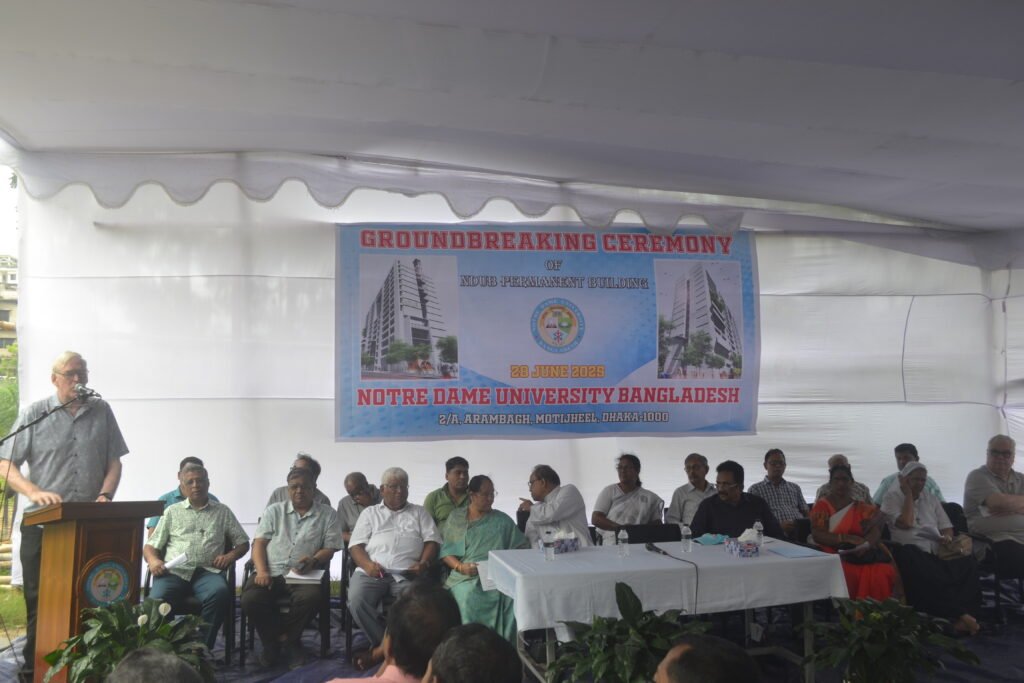
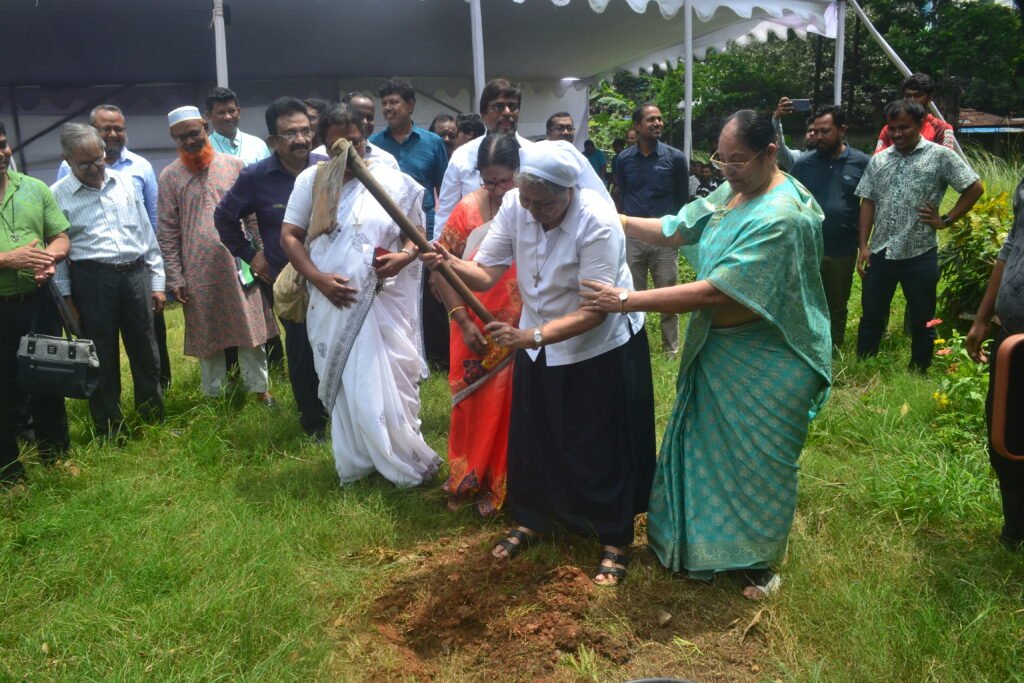
Notre Dame University Bangladesh (NDUB) took a significant step toward establishing its permanent building in the capital’s Motijheel area with a groundbreaking ceremony on Saturday (June 28, 2025). The event was attended by university officials, faculty members, students, and distinguished guests.
The program, held at the construction site, began with a project overview by Engr. Md. Taslim Uddin Jomadder, NDUB’s Chief Engineer, who detailed the construction plans for the first phase of the project.
Vice Chancellor Dr. Fr. Patrick D. Gaffney, CSC, Pro-Vice Chancellor Dr. Fr Charles B Gordon, CSC, Treasurer and Acting Proctor Dr. Fr Subash Adam Pereira, CSC, and Fr. James Clement Cruze, CSC, Development Director and Project Coordinator, delivered insightful speeches on the occasion, emphasizing the significance of the permanent building for the university’s future.
“This permanent building represents our commitment to providing world-class education in Bangladesh. The new facilities will allow us to enhance both teaching and research capabilities while serving our students better,” they stated.
Other notable attendees included Fr. George Kamal Rozario, CSC, Chairman of the Board of Trustees (BoT), Prof. Mahfuza Khanom and Firoze A. Akhtar, BoT members, Prof. Aloke Kumar Chakraborty, Dean of NDUB, Fr. Ashim T. Gonsalves, CSC, Deputy Registrar, Fr. Nitto Ekka, CSC, Assistant Registrar, and Fr. Swapan A. Das, CSC, Assistant Registrar, who shared their perspectives on the project’s long-term impact.
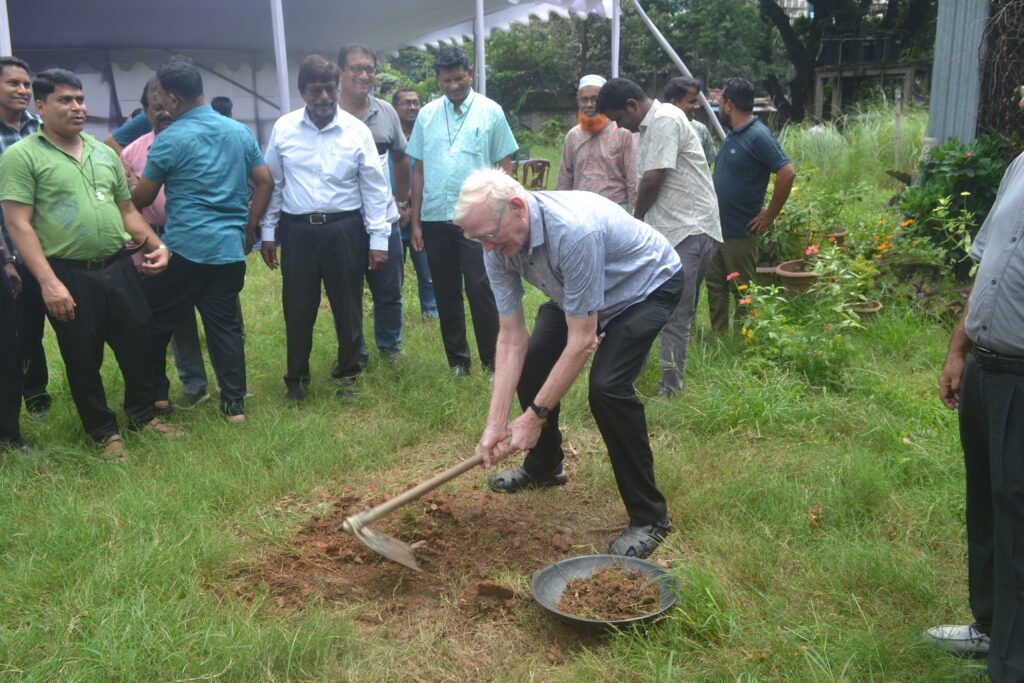
The highlight of the event was the formal handover of the construction site by the Vice Chancellor to the construction company. A prayer of blessing was led by Fr. George Kamal along with Fr. Swapan. The ceremony concluded with the traditional groundbreaking, where university officials turned the first soil with ceremonial spades.
NDUB, currently operating from a temporary building, expects the permanent facility to help meet increasing demand for quality higher education in the country. The university offers undergraduate and graduate programs across various disciplines including Business Administration, Computer Science and Engineering, English, law, Microbiology, and Economics. The new building, expected to be completed within four years, will feature modern academic facilities including smart classrooms, research laboratories, a digital library, and student common areas. The multi-storied complex is being built to accommodate the university’s growing student population and expanding academic programs.