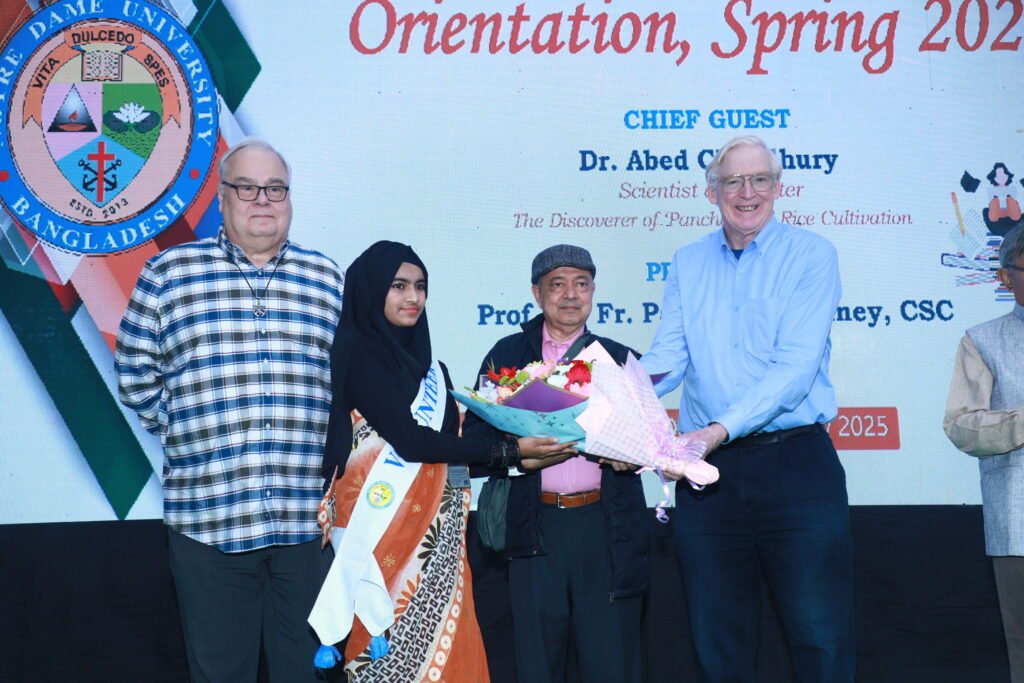
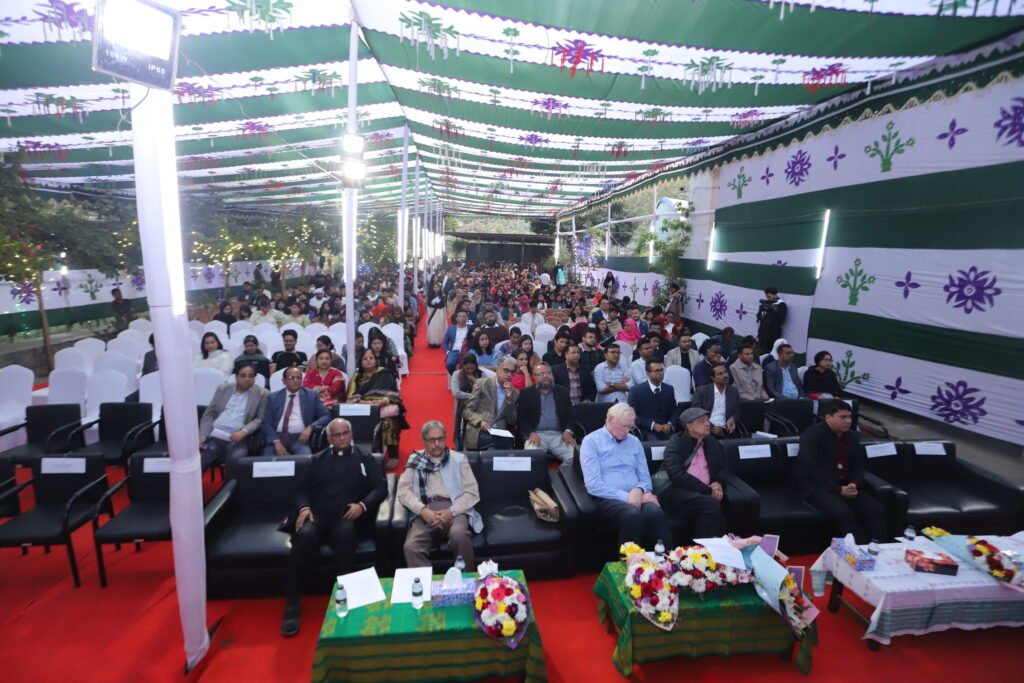
Notre Dame University Bangladesh (NDUB) hosted an orientation program on Saturday (January 11) to warmly welcome the new students of Spring 2025, along with their guardians, offering them flowers as a symbol of hospitality.
The event featured renowned scientist Dr. Abed Chaudhury, discoverer of the ‘Panchabrihi’ rice, as the chief guest.
Quoting Robert Frost’s famous lines, “The woods are lovely, dark, and deep; But I have promises to keep; And miles to go before I sleep,” Dr. Chaudhury spoke about the importance of choosing less-traveled, innovative paths in life. He shared how his decision to follow a different path led to the innovation of Panchabrihi rice cultivation, allowing farmers to harvest five times a year – one ‘Boro’ crop, followed by two ‘Aus’ and two ‘Amon’ crops.
He inspired students by saying, “If you want to change the world, you must choose a unique path, a road less-traveled.”
NDUB’s Vice Chancellor, Dr. Fr. Patrick D. Gaffney, CSC, delivered an opening address, emphasizing the university’s commitment to guiding students toward a future shaped by values, vision, and the pursuit of unique paths.
Furthermore, Pro-Vice Chancellor Dr. Fr. Charles B. Gordon, CSC, and Treasurer Dr. Fr. Subash Adam Pereira, CSC, delivered encouraging speeches to the new students, suggesting them to remain hungry for learning.
The Public Relations Office presented a documentary showcasing the university’s accomplishments and activities. Deputy Registrar Fr. Ashim Theotonius Gonsalves, CSC, introduced the university’s administration and faculty, followed by Deputy Exam Controller Fr. Badhon Hilarious Rozario, CSC, who introduced the different administrative offices to the students.
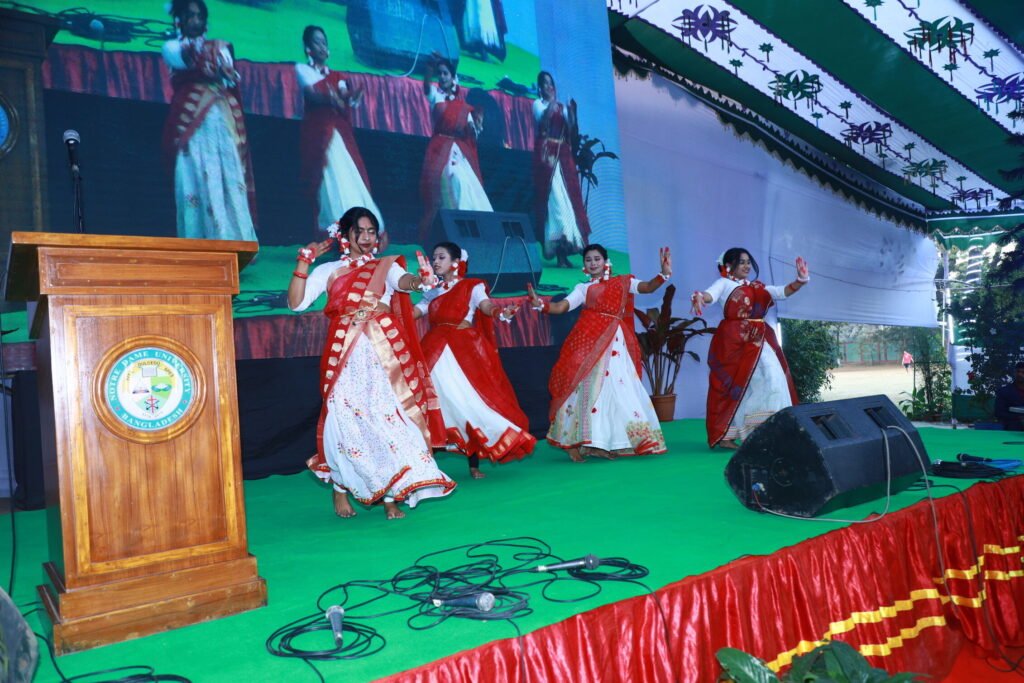
NDUB’s current student Maherun Islam Payel (LLB, Batch-20) shared her experiences at NDUB, while new student Valentia Elena Biswas (BBA) expressed her excitement about beginning her journey at the university. Deputy Proctor Stanly Pius Rozario and Deputy Director of Student Affairs Sr. Shagorica Maria Gomes, CSC, gave presentations on disciplines and various club activities respectively. The program also featured cultural performances by students and teachers, including dances and group songs